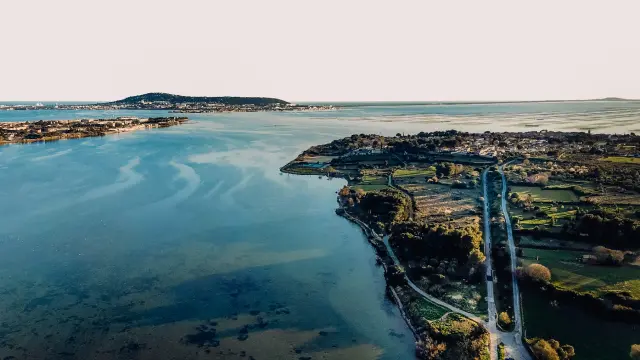
Beneath the waters of the Thau lagoon lies a little-known treasure: one of the largest seagrass beds on the Languedoc coast. These submerged meadows cover nearly a third of the lagoon, or 2,400 hectares. Two species coexist: Zostera marina and Zostera noltii, marine plants that resemble long grasses swaying in the current.
These seagrass beds play a crucial role. Acting as a nursery for fish, a spawning ground and a prime habitat for dozens of species, they fulfil the triple function of refuge, larder and nursery. Their state of conservation reflects the good health of the lagoon. The absence of tides in the Mediterranean provides them with ideal conditions: a constant water depth that prevents freezing and allows them to be maintained through vegetative reproduction.
As for aquatic fauna, the figures speak for themselves. The lagoon is home to 88 species of fish, including 16 sedentary species such as the spotted seahorse, the peacock blenny and the spirograph. Of these, 17 are considered rare and 40 exceptional. There are 70 species of molluscs (cuttlefish, clams, oysters, mussels), 110 species of crustaceans (crabs, prawns, sea fleas), and 12 species of echinoderms (starfish, sea urchins), not to mention 18 species of coelenterates (corals, anemones, jellyfish).
Plankton is also abundant: 125 species of zooplankton (microscopic crustaceans, fish and mollusc larvae), over 100 species of protozoa, 196 species of plants and 100 species of phytoplankton. This extraordinary abundance explains why the lagoon reaches a maximum depth of 11 metres, making it the deepest in the Languedoc after the Étang de Berre.